This site uses affiliate links to Amazon.com Books for which IANDS can earn an affiliate commission if you click on those links and make purchases through them.
1. Introduction to Reincarnation in Judaism
From time to time in Jewish history, there was an insistent belief that biblical personalities were “raised up” from the dead – not as an end-of-time bodily resurrection – but as an ongoing process of reincarnation (gilgul). Evidence of reincarnation can be found in the Hebrew Bible, the Rabbinical Jewish Talmud, the Jewish Essene’s Dead Sea Scrolls, early Judeo-Christian and Jewish Gnostic writings, the Judeo-Christian New Testament, Jewish mysticism, and the writings of ancient Jewish historians. At the time of Jesus, there were many competing ideas concerning death and what happens afterward. Neoplatonic concepts of reincarnation, Persian resurrection, ancient Hebrew ideas of “Sheol“, beliefs in no afterlife at all, and religions and philosophies from other sources, all existed among the Jews in those days.
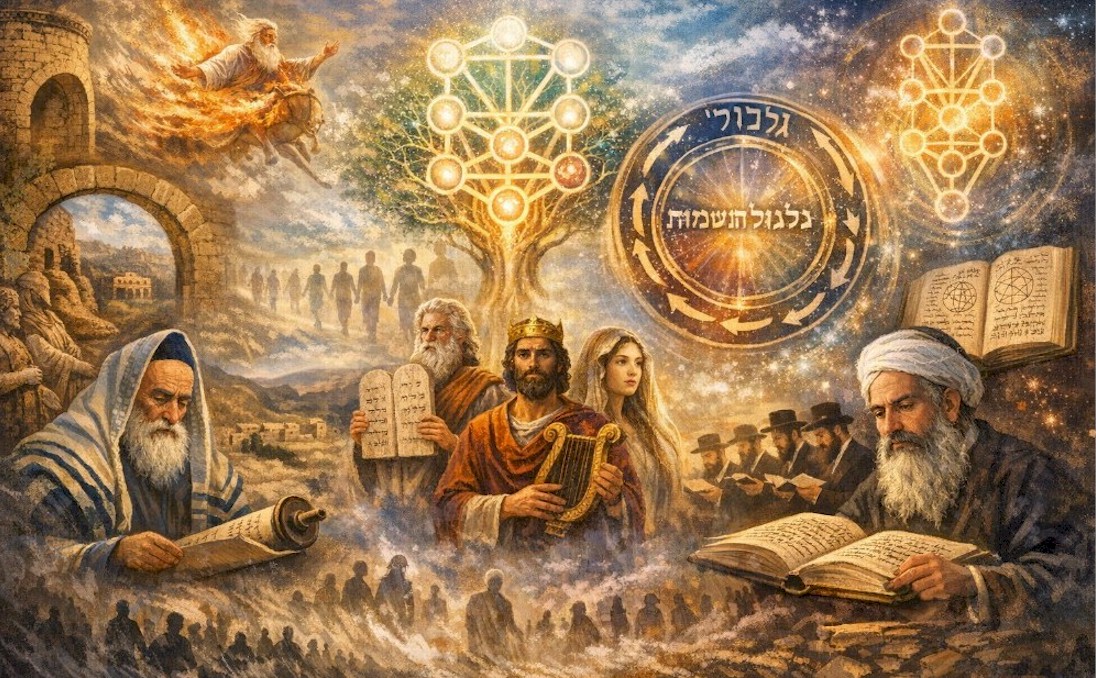
Reincarnation in Judaism is usually discussed under the Hebrew term “gilgul ha-neshamot” which means “cycling of souls.” While it is not a central doctrine of biblical or rabbinic Judaism, gilgul becomes an important idea in Jewish mysticism, especially in medieval and early modern Kabbalah. The esoteric explanations of gilgul were articulated in Jewish mysticism by Isaac Luria in the 16th century, as part of the metaphysical purpose of Creation. Gilgul is a universal belief in Hasidic Judaism, which regards the Kabbalah as sacred and authoritative. The Kabbalah is an esoteric method, discipline and school of thought in Jewish mysticism.
2. Reincarnation in the Hebrew Bible
Many people assume the Hebrew Bible teaches a simple story about life. You live once; you die; then you are judged. Your fate is settled forever. But when you read the texts closely, a more nuanced picture appears. This is especially true in Hebrew poetry, prophecy, and wisdom writings. Across many books, the Hebrew scriptures talk again and again about descent and return. They describe restoration after death and new life after loss. God’s actions are often said to happen not just once, but “twice, three times,” and even more. These repeated patterns raise an important question. Did the biblical writers see human destiny as a single, one-time event? Or did they see it as something that unfolds in stages over time?
This section looks at passages from the Hebrew Bible that later Jewish mystics, early Christian thinkers, and modern scholars have linked to the idea of reincarnation. These texts do not lay out a formal theory in modern terms. They do not explain reincarnation step by step. Instead, they hint at it through images and themes. These include return, renewal, rebirth, rescue from Sheol, repeated correction by God, and the cycling of generations.
The passages below are grouped by theme. They look at (a) verses that describe souls returning from Sheol or heaven to new life on Earth, (b) teachings about salvation for all that suggest universal healing after death, (c) divine justice shown as moral cause and effect, similar to karmic law, (d) references to the soul existing before birth, and (e) stories about angels or “fallen” beings that point to descent into human life. When read as a whole, these themes suggest a worldview where God’s work with the soul continues over time. It is meant to correct and restore, not to end forever after one lifetime.
- Read more about Reincarnation in the Judeo-Christian Bible.
What follows is a close reading of the biblical text itself. The goal is to let the Bible’s own language of return, renewal, and repetition speak for itself.
a. God Raises the Dead From Sheol and Heaven
The following Bible verse describes God bringing up the dead from Sheol, and bringing those in heaven back down to Earth – a good description of reincarnation:
“Though they dig into Sheol, from there shall my hand take them; though they climb up to heaven, from there I will bring them down.” (Amos 9:2)
The next Bible verse states that God is raising souls to life from Sheol rather than waiting for an End of Days resurrection.
“The Lord brings death and makes alive; he brings down to Sheol and raises up.” (1 Samuel 2:6-8)
In the next passage, the author of Job states that he will return to the womb after death which can only occur through reincarnation.
“Then Job arose, tore his robe, shaved his head, and fell on the ground and worshiped. He said, ‘Naked I came from my mother’s womb, and naked shall I return there; the Lord gave, and the Lord has taken away; blessed be the name of the Lord.'” (Job 1:20-21)
In the next passage, the author of Job states that he will be alive on Earth after death to see God which can only happen through reincarnation.
“I know that my redeemer lives, and that in the end he will stand on the Earth. And after my skin has been destroyed, yet in my flesh I will see God; I myself will see him with my own eyes — I, and not another. How my heart yearns within me!” (Job 19:25-27)
In the next passage, God acts repeatedly with the same person to rescue from death (“the pit“) and the result is renewed “life” and “light”. It shows that God gives a soul multiple chances at life in order to learn, repent, or be restored.
“God indeed does all these things, twice, three times, with mortals, to bring back their souls from the pit, so that they may see the light of life.” (Job 33:29-30)
In the above passage, later Talmud sources commonly cite this as a gilgul allusion, including presentations of Sha’ar HaGilgulim in English.
In the next passage, God restores life again and again. “Restore” (shuv, to return) implies bringing the soul back, not creating something new once and forever.
“He restores my soul. He leads me in right paths for his name’s sake.” (Psalm 23:3)
In the next passage, God is said to restore to life from Sheol:
“O Lord, you brought up my soul from Sheol, restored me to life from among those gone down to the Pit.” (Psalm 30:3)
Here is another passage where God is said to restore a soul to life from Sheol:
“But God will ransom my soul from the power of Sheol, for he will receive me.” (Psalm 49:15)
In the above passage, the phrase “receive me” (Hebrew laqach) implies taking back into active existence, not waiting for a distant final resurrection.
“You who have made me see many troubles and calamities will revive me again; from the depths of the Earth you will bring me up again.” (Psalm 71:20)
In the above passage, the repetition (“again… again”) strongly suggests multiple restorations, not a single end-of-time event.
In the next passage, life is given again after loss, with restoration language rather than final resurrection.
“Then we will never turn back from you; give us life, and we will call on your name. Restore us, O Lord God of hosts.” (Psalm 80:18–19)
In the next passage, God restores life repeatedly. “Again” implies repeated restoration, not a single irreversible event.
“Will you not revive us again, so that your people may rejoice in you?” (Psalm 85:6)
In the next passage, deliverance from the depths of Sheol implies a return to life, not waiting for an end-time resurrection.
“For great is your steadfast love toward me; you have delivered my soul from the depths of Sheol.” (Psalm 86:13)
In the next passage, God is described sending souls back to Earth after death.
“Before the mountains were brought forth or ever [God] had formed and given birth to the Earth and the world, even from everlasting to everlasting You are God. You turn man back to dust and corruption, and say, ‘Return, O sons of the earthborn to the Earth!‘ For a thousand years in Your sight are but as yesterday when it is past, or as a watch in the night. You carry away these disobedient people, doomed to die within forty years as with a flood; they are as a sleep vague and forgotten as soon as they are gone. In the morning they are like grass which grows up — In the morning it flourishes and springs up; in the evening it is mown down and withers.” (Psalm 90:2-6)
In the next passage, redemption from “the Pit” implies return from death, not waiting for an end-of-ages resurrection.
“[God] who redeems your life from the Pit, who crowns you with steadfast love and mercy.” (Psalm 103:4)
In the next passage, death is followed by a new creation through God’s spirit, described as an ongoing process, not a one-time eschatological event.
“When you hide your face, they are dismayed; when you take away their breath, they die and return to their dust. When you send forth your spirit, they are created; and you renew the face of the ground.” (Psalm 104:29–30)
The next passage has a reincarnational interpretation:
“Return to your rest, my soul, for the Lord has been good to you. For you, Lord, have delivered me from death, my eyes from tears, my feet from stumbling, that I may walk before the Lord in the land of the living.” (Psalm 116:7-9)
In the above passage “return” implies the soul has departed before and is returning again. “Rest” suggests an intermediate state – a pause between incarnations, akin to later Jewish ideas of Olam ha-Neshamot (the world of souls). Crucially, the psalm does not say “the land of the dead” or a final heavenly realm. Instead, “the land of the living” strongly implies continued embodied existence.
The next Bible verse is in Lamentations where the author asks God to renew his life by allowing him to return to life which is suggestive of reincarnation:
“You, Lord, reign forever; your throne endures from generation to generation. Why do you always forget us? Why do you forsake us so long? Restore us to yourself, Lord, that we may return; renew our days as of old unless you have utterly rejected us and are angry with us beyond measure.” (Lamentations 5:19-22)
While the next passage is often read as resurrection, the text lacks finality, judgment, or eternal transformation language – only return to life.
“Your dead shall live; their bodies shall rise. You who dwell in the dust, awake and sing for joy! For your dew is a dew of light, and the Earth will give birth to the dead.” (Isaiah 26:19)
In the above passage, the “resurrection” involves child birth which is suggestive of reincarnation.
In the next passage, life is restored after divine judgment, with no indication this restoration happens only once.
“O Lord, by these things people live, and in all these is the life of my spirit. Oh, restore me to health and make me live!” (Isaiah 38:16)
In the next passage, God revives spirits repeatedly, implying restoration rather than final termination.
“I dwell… with those who are contrite and humble in spirit, to revive the spirit of the humble, and to revive the heart of the contrite. For I will not continually accuse, nor will I always be angry; for then the spirit would grow faint before me.” (Isaiah 57:15–16)
In the next passage, the author of the Book of Isaiah clarifies how the return of the Jews to Zion, through “resurrection,” will be through childbirth and therefore reincarnation.
“Can a country be born in a day or a nation be brought forth in a moment? Yet no sooner is Zion in labor than she gives birth to her children. Do I bring to the moment of birth and not give delivery?’ says the Lord. ‘Do I close up the womb when I bring to delivery?’ says your God. ‘Rejoice with Jerusalem and be glad for her, all you who love her; rejoice greatly with her, all you who mourn over her. For you will nurse and be satisfied at her comforting breasts; you will drink deeply and delight in her overflowing abundance.’ For this is what the Lord says: ‘I will extend peace to her like a river, and the wealth of nations like a flooding stream; you will nurse and be carried on her arm and dandled on her knees. As a mother comforts her child, so will I comfort you; and you will be comforted over Jerusalem.’ When you see this, your heart will rejoice and you will flourish like grass; the hand of the Lord will be made known to his servants, but his fury will be shown to his foes.” (Isaiah 66:3-14)
In the Book of Job, Job wonders if he will live again after death:
“If someone dies, will they live again? All the days of my hard service I will wait for my renewal to come.” (Job 14:14)
Job answers his own question by saying he will live again when he is renewed. According to the Hebrew dictionary, the word translated “renewal” is “chaliyphah” (pronounced “khal-ee-faw”). In the 12 occurrences of this word in the Bible, 8 times it is used to mean a “change in garments.” In 2 occurrences, including Job 14:14, it is used in reference to death which are obvious references to a “change in bodies” or reincarnation.
The Jewish Kabbalists interpreted the following passage to mean a generation dies and subsequently returns through reincarnation.
“A generation goes, and a generation comes, but the Earth remains forever. The sun rises and the sun goes down, and hurries to the place where it rises. The wind blows to the south, and goes around to the north; round and round goes the wind, and on its circuits the wind returns. All streams run to the sea, but the sea is not full; to the place where the streams flow, there they continue to flow. All things are wearisome; more than one can express; the eye is not satisfied with seeing, or the ear filled with hearing. What has been is what will be, and what has been done is what will be done; There is nothing new under the sun.” (Ecclesiastes 1:4-9)
In context of the other cycles mentioned: the sun, the wind, the streams, etc., the cycle of generations as the reincarnation of generations, is an obvious interpretation. In a normal cycle of reincarnating souls, the same generation of souls cannot reincarnate until the previous generation of the same souls have passed away. The key to this passage of scripture is verse 9 where it states: “What has been is what will be.” Due to the fact that verse 9 applies to the “generation” of people, this can only be a reference to reincarnation.
Also notice in verse 6 the Greek translation of the Hebrew word for wind, pneuma, is the same for the Hebrew word for spirit:
“The wind blows to the south, and goes around to the north; round and round goes the wind, and on its circuits the wind returns.” (Ecclesiastes 1:6)
The verse following Ecclesiastes 1:4-9 yields yet another reference to reincarnation:
“Is there a thing of which it is said, ‘See, this is new?’ It has already been, in the ages before us. The people of long ago are not remembered, nor will there be any remembrance of people yet to come by those who come after them.” (Ecclesiastes 1:10-11)
In the above verse, the writer of the Book of Ecclesiastes makes an important reference to reincarnation when describing the “veil of memory” which causes people to not remember their previous lifetimes. This shows the entire verse in Ecclesiastes 1:4-11 is using the cycle of reincarnation as the most important cycle of life in God’s natural creation.
In yet another verse, the writer of Ecclesiastes again mentions God’s cycle of life which is suggestive of reincarnation:
“What is happening now has happened before, and what will happen in the future has happened before, because God makes the same things happen over and over again.” (Ecclesiastes 3:15)
This textual openness of Hebrew scriptures concerning “resurrection” as repeated embodiments is exactly why later Jewish mystics and early Christian thinkers felt free to teach reinncarnation without believing they were contradicting scripture.
b. The Hebrew Bible on Universal Salvation Implying Reincarnation
Universal salvation is the doctrine of universal reconciliation — the view that all human beings will ultimately be restored to a right relationship with God. It is the belief that God’s infinite love and mercy is such that God is not willing for anyone to be lost. Therefore, God has a plan of salvation for everyone — even after death. One major plan involves reincarnation which allows people to “work their way up” through the afterlife realms immediately after death with the goal of becoming permanent citizens once again in the highest heaven — the soul’s original home.
Universalism is a doctrine supported by numerous Bible verses. According to religious studies scholar, Dr. Ken R. Vincent, the number of Bible verses supporting universal salvation is second in number only to those advocating salvation by “good works.” Universal salvation does not assume the nonexistence of hell; but assumes hell to be a spiritual condition of purification which doesn’t last forever. In this sense, hell is more like the Catholic notion of Purgatory.
The following Bible verses describe God’s mercy and refutes the concept of eternal damnation. And because the Bible does so, it also implies God gives people opportunities of salvation after death:
“For no one is cast off by the Lord forever. Though he brings grief, he will show compassion, so great is his unfailing love. For he does not willingly bring affliction or grief to anyone.” (Lamentations 3:31-33)
“I will not accuse them forever, nor will I always be angry, for then they would faint away because of me — the very people I have created.” (Isaiah 57:16)
The following Bible verses clearly states it is God’s will for everyone to be saved and this implies reincarnation. And there should be no doubt about this: nothing can thwart God’s will from being accomplished. If God wills everyone to be saved, then everyone will be saved and this implies reincarnation until everyone is saved:
“I know that you (God) can do all things; no purpose of yours can be thwarted.” (Job 42:2)
“He (God) does as he pleases with the powers of heaven and the peoples of the Earth. No one can hold back his hand or say to him: ‘What have you done?'” (Daniel 4:35)
So the question is not, “Will everyone be saved?,” because Lamentations 3:31-33 says it is God’s will that everyone be saved. And because nothing can thwart God’s will, the only logical conclusion is that everyone will be saved. These combined Bible verses prove beyond doubt the reality of universal salvation. So the real question is, “How is everyone saved?,” because it is obvious that a countless number of people have died without salvation. Therefore, God must have a plan of salvation for such people after their death. Obviously, one such plan of salvation is through reincarnation. Given enough opportunities and lifetimes, everyone will return to God. The following are more Bible verses supporting the doctrine of universal salvation implying an “after death” plan of salvation such as reincarnation:
“The Lord will lay bare his holy arm in the sight of all the nations, and all the ends of the Earth will see the salvation of our God.” (Isaiah 52:10)
“All the ends of the Earth will remember and turn to the Lord, and all the families of the nations will bow down before him.” (Psalm 22:27)
“You who answer prayer, to you all people will come. When we were overwhelmed by sins, you forgave our transgressions.” (Psalm 65:2-3)
“All the nations you have made will come and worship before you, Lord; they will bring glory to your name.” (Psalm 86:9)
c. God’s Law of Divine Justice Defined as Karma and Reincarnation
The Hebrew Bible is filled with references to karma; and therefore, reincarnation. Here is a list of some of them:
“Whoever sheds human blood, by humans shall their blood be shed; for in the image of God has God made mankind.” (Genesis 9:6)
“They sow the wind and reap the whirlwind.” (Hosea 8:7)
“As I have observed, those who plow evil and those who sow trouble reap it.” (Job 4:8)
“As you have done, it will be done to you; your deeds will return upon your own head.” (Obadiah 1:15)
“Whoever digs a pit will fall into it; if someone rolls a stone, it will roll back on them.” (Proverbs 26:27)
- Read more about Karma and the NDE.
d. The Pre-Existence of the Soul Implies Reincarnation
Pre-existence is the doctrine of the soul not being created at birth; but rather the soul exists before birth in heaven and/or in past lives on Earth. All Bible verses referring to reincarnation assumes the reality of the pre-existence of the soul. All Bible verses referring to pre-existence of the soul implies the reality of reincarnation. Both concepts of reincarnation and pre-existence are inseparable and both concepts were common knowledge in biblical times. For example, the idea of a person sinning before birth can also be found in the Hebrew Bible:
“Surely I was sinful at birth, sinful from the time my mother conceived me.” (Psalm 51:5)
“Before I formed you (Jeremiah) in the womb I knew you, before you were born I set you apart; I appointed you as a prophet to the nations.” (Jeremiah 1:5)
“What has been will be again, what has been done will be done again; there is nothing new under the sun.” (Ecclesiastes 1:9)
“Before I was born the Lord called me; from my mother’s womb he has spoken my name.” (Isaiah 49:1)
- Read more about Pre-Existence and the NDE.
e. Fallen Angels as Reincarnating Human Beings
In Genesis 28, the concept of reincarnation appears through the continued coming and going of spirits (described as “angels” of God) from the Earth to the spiritual realm. Jacob, son of Isaac and grandson of Abraham, had a dream in which he saw a “stairway” on the Earth reaching to heaven:
“He (Jacob) had a dream in which he saw a stairway resting on the Earth, with its top reaching to heaven, and the angels of God were ascending and descending on it.” (Genesis 28:12)
This story of “Jacob’s Ladder” describes “angels” ascending and descending a heavenly “stairway.” Ascending this stairway implies death and going to heaven. Descending this stairway implies returning to Earth and reincarnation. The clue is in the phrase “resting on the Earth” meaning the “stairway” is positioned upon Earth where the body is located. This verse in Genesis and the concept of spirit beings entering and leaving the Earth realm through divine means is supported by other Bible verses dealing with reincarnation such as the following:
“Though they dig into Sheol, from there shall my hand take them; though they climb up to heaven, from there I will bring them down.” (Amos 9:2)
The idea of a “stairway to heaven” is also a useful metaphor for the NDE tunnel which so many NDErs travel through during their NDEs. One particular experiencer, David Oakford, provided an excellent description of the NDE tunnel resembling the description of “Jacob’s Ladder”:
“We started to head back toward Gaia (the personal name for Earth). We went to a place in the shadow of Gaia. It was a great city in the clouds… I saw spirits going to and from Gaia and the city. I could tell the development of the spirits going to and from by the energy they emanated. I could see that animals came to and from Gaia just like humans do. I could see many spirits leave Gaia with guides and could see spirits returning to Gaia without guides. The Being told me that some of the spirits passing were the ones that were doing the work with humans on Gaia. I could make out the type of spirits that were doing the work and the spirits that were coming to the great city to become replenished to eventually go back to Gaia to experience and further evolve. I could feel the emotions of the ones coming back for replenishment. I could feel that some of them were sad, beaten and scared, much like I felt before my Being came to me.” (David Oakford)
One very interesting proof in the Bible of angels reincarnating as humans can be found in the story of the Nephilim:
“When human beings began to increase in number on the Earth and daughters were born to them, the sons of God saw that the daughters of humans were beautiful, and they married any of them they chose… The Nephilim were on the Earth in those days — and also afterward — when the sons of God went to the daughters of humans and had children by them. They were the heroes of old, men of renown.” (Genesis 6:1-4)
Why the story of the Nephilim (fallen angels) is a metaphor for fallen souls:
(1) Angels don’t have genitals and cannot have sex. So the “children” of the union between “daughters of humans” and the “sons of God” is a metaphor for something else. NDE studies reveal that spiritual bodies don’t have genitals.
(2) Angels neither marry nor are given in marriage as Jesus indicated in Matthew 22:23-30. So the “marriage” of the “sons of God” and the “daughters of humans” is a metaphor for something else.
(3) The Hebrew word for “Nephilim” has been mistranslated as “giants” when the actual translation is “those who fell” (another reference appears in Ezekiel 32:27 translated as “the fallen warriors of old”).
(4) The famous Christian mystic and NDEr, Edgar Cayce (1877-1945), gave the correct interpretation of the Nephilim story to mean when souls fell from heaven and began possessing the bodies of homo erectus “ape-men” during the process of evolution thereby creating the human race.
(5) Early Judeo-Christian writers such as Justin Martyr, Eusebius, Clement of Alexandria, Origen, and Commodian believed the “sons of God” in Genesis 6:1-4 were “fallen angels” — fallen souls from heaven.
(6) In the Book of Job, the “sons of God” are described existing in heaven before the Earth was created. The “morning stars” are another name for “sons of God”:
“Where were you when I began building the Earth? Tell Me, if you have understanding. Who decided how big it was to be, since you know? Who looked to see if it was as big as it should be? What was it built upon? Who laid its first stone, when the morning stars sang together and all the sons of God called out for joy?” (Job 38:4-7)
(7) Satan as a Reincarnating Human Being
There are two specific instances in the Hebrew Bible where Satan is referred to as a man. One of them is in Ezekiel 28 where the King of Tyre is referred to as an incarnation of Satan. In Ezekiel 27, God condemns the city of Tyre because of its many sins and its dishonest trade. Then in Ezekiel 28, God condemns the King of Tyre himself:
“The word of the Lord came to me: ‘Son of man, take up a lament concerning the king of Tyre and say to him: ‘This is what the Sovereign Lord says: ‘You were the seal of perfection, full of wisdom and perfect in beauty. You were in Eden, the garden of God; every precious stone adorned you: carnelian, chrysolite and emerald, topaz, onyx and jasper, lapis lazuli, turquoise and beryl. Your settings and mountings were made of gold; on the day you were created they were prepared. You were anointed as a guardian cherub, for so I ordained you. You were on the holy mount of God; you walked among the fiery stones. You were blameless in your ways from the day you were created till wickedness was found in you. Through your widespread trade you were filled with violence, and you sinned. So I drove you in disgrace from the mount of God, and I expelled you, guardian cherub, from among the fiery stones. Your heart became proud on account of your beauty, and you corrupted your wisdom because of your splendor. So I threw you to the Earth; I made a spectacle of you before kings. By your many sins and dishonest trade you have desecrated your sanctuaries. So I made a fire come out from you, and it consumed you, and I reduced you to ashes on the ground in the sight of all who were watching. All the nations who knew you are appalled at you; you have come to a horrible end and will be no more.’” (Ezekiel 28:11-19)
The second instance is in Isaiah 14 where the King of Babylon is referred to as an incarnation of Lucifer (the “morning star”, son of the dawn):
“On the day the Lord gives you relief from your suffering and turmoil and from the harsh labor forced on you, you will take up this taunt against the king of Babylon… “How you have fallen from heaven, morning star, son of the dawn! You have been cast down to the Earth, you who once laid low the nations! You said in your heart, ‘I will ascend to the heavens; I will raise my throne above the stars of God; I will sit enthroned on the mount of assembly, on the utmost heights of Mount Zaphon. I will ascend above the tops of the clouds; I will make myself like the Most High.’ But you are brought down to the realm of the dead, to the depths of the pit. Those who see you stare at you, they ponder your fate: ‘Is this the man who shook the Earth and made kingdoms tremble, the man who made the world a wilderness, who overthrew its cities and would not let his captives go home?'” (Isaiah 14:3-17)
The Book of Enoch, an ancient Jewish apocalyptic religious text, was cherished by the Essenes, ancient Jews and early Christians. The Book of Enoch contains unique material on the origins of demons and Nephilim, why some angels fell from heaven, an explanation of why the Genesis flood was morally necessary, and a prophetic exposition of the thousand-year reign of the Messiah. The premise of the Book of Enoch is how angels left their positions in heaven and incarnated into human bodies (the “Nephilim”).
Another extra-Biblical text, the Book of Jubilees, describes how the archangels bound the “ancestors” of the Nephilim, the fallen “angels” (souls) referred to as “the Watchers,” in the “depths of the Earth” and imprisoned them in great darkness in a mysterious “second heaven.” This “outer darkness” realm appears in many NDEs as a transitory realm known as The Void. The Book of Jubilees was considered canonical by Beta Israel (Ethiopian Jews) as well as the Ethiopian Orthodox Church. This is important because the Ethiopian Orthodox Bible is the largest and most diverse biblical canon in traditional Christendom having escaped the political purges of the Roman Church. So the Book of Jubilees is considered part of the Pseudepigrapha by Protestant, Roman Catholic, and Eastern Orthodox Churches. The Book of Jubilees was well known to early Christians, as evidenced by the writings of Origen, Epiphanius, Justin Martyr and others. The text was also utilized by the Essene community of the Dead Sea Scrolls.
f. The Hebrew Bible on the Nation of Israel Reincarnated
The Book of Ezekiel contains in detail those elements necessary for the reincarnation of the spirit. Until Aristotle (384-322 BC), the ancients believed emotional functions took place in the heart where they believed the soul was located. The understanding of emotional functions being carried out in the brain is a relatively modern idea. Because of this, whenever the prophet Ezekiel (622-570 BC) refers to the “heart” he is really referring to the soul. For this reason, when Ezekiel described how a person is given a new life, he not only receives a new spirit (ruach) but also a new soul (nephesh):
“The word of the Lord came to me: ‘Son of man, the people of Jerusalem have said of your fellow exiles and all the other Israelites, ‘They are far away from the Lord; this land was given to us as our possession.” ‘Therefore say: ‘This is what the Sovereign Lord says: Although I sent them far away among the nations and scattered them among the countries, yet for a little while I have been a sanctuary for them in the countries where they have gone. Therefore say: ‘This is what the Sovereign Lord says: I will gather you from the nations and bring you back from the countries where you have been scattered, and I will give you back the land of Israel again. They will return to it and remove all its vile images and detestable idols. I will give them an undivided heart and put a new spirit in them; I will remove from them their heart of stone and give them a heart of flesh.” (Ezekiel 11:14-19)
“Rid yourselves of all the offenses you have committed, and get a new heart and a new spirit. Why will you die, people of Israel?” (Ezekiel 18:31)
In the following Bible verse, Hosea‘s prophecy to redeem Israel from the grave is associated with childbirth implying reincarnation:
“You are destroyed, Israel, because you are against me, against your helper… The guilt of Ephraim is stored up, his sins are kept on record. Pains as of a woman in childbirth come to him, but he is a child without wisdom; when the time arrives, he doesn’t have the sense to come out of the womb. I will deliver this people from the power of the grave; I will redeem them from death. Where, O death, are your plagues? Where, O grave, is your destruction?” (Hosea 13:9-14)
The prophet Isaiah gave a similar prophecy associating childbirth with reincarnation:
“We were with child, we writhed in labor, but we gave birth to wind. We have not brought salvation to the Earth, and the people of the world have not come to life. But your dead will live, Lord; their bodies will rise — let those who dwell in the dust wake up and shout for joy — your dew is like the dew of the morning; the Earth will give birth to her dead.” (Isaiah 26:18-19)
In the next Bible verse, Jeremiah‘s prophecy compared a potter, reshaping a pot from a marred lump of clay and then reforming it to another pot, to what God does to the people of Israel which has reincarnation implications:
“This is the word that came to Jeremiah from the Lord: ‘Go down to the potter’s house, and there I will give you my message.’ So I went down to the potter’s house, and I saw him working at the wheel. But the pot he was shaping from the clay was marred in his hands; so the potter formed it into another pot, shaping it as seemed best to him. Then the word of the Lord came to me. He said, ‘Can I not do with you, Israel, as this potter does?‘ declares the Lord. ‘Like clay in the hand of the potter, so are you in my hand, Israel.‘” (Jeremiah 18:1-6)
Ezekiel 37 is the famous passage about the “Valley of the Dry Bones,” a metaphorical event which has been taken in its most literal sense by Christian theologians. The clue to the interpretation of this metaphor is in the description of the bones that “they were very dry” (verse 2) which is repeated to leave no doubt as to the meaning: from “the dust of the ground,” as understood in Genesis 2:7.
When Ezekiel followed God’s orders speaking to the dry bones, he is in fact telling them from dust they will sprout flesh again in order to be finally endowed with spirit. Ultimately, the spirit returns to God to eventually reincarnate in new bodies. The key verse in Ezekiel 37 is here:
“Then you, my people, will know that I am the Lord, when I open your graves and bring you up from them. I will put my Spirit in you and you will live, and I will settle you in your own land.” (Ezekiel 37:13-14)
Because Israel did indeed return to their homeland after exile in Babylon, the only way the above verse could have occurred is through reincarnation. Notice also this negates a final end time corpse resurrection.
The Hebrew Bible frequently mentions that God caused specific people to be “raised up” from the dead which is suggestive of reincarnation and denies an end of time corpse resurrection. The following are some examples:
“I will raise up Cyrus to fulfill my righteous purpose, and I will guide his actions. He will restore my city and free my captive people — without seeking a reward! I, the Lord of Heaven’s Armies, have spoken!” (Isaiah 45:13)
“For I am going to raise up a shepherd over the land who will not care for the lost, or seek the young, or heal the injured, or feed the healthy, but will eat the meat of the choice sheep, tearing off their hooves.” (Zechariah 11:16)
“You may say, ‘The Lord has raised up prophets for us in Babylon.'” (Jeremiah 29:15)
3. Reincarnation of Hebrew Prophets and Personalities
From time to time in Jewish history, there was an insistent belief that their prophets were reincarnated. In both Old and New Testament times, it was common knowledge for God to occasionally reincarnate prophets to warn the people of Israel.
a. Hebrew Prophets Reincarnated
The following are some verses in the Hebrew Bible concerning the reincarnation of Hebrew prophets:
“I also raised up prophets from among your children and Nazirites from among your youths. Is this not true, people of Israel?’ declares the Lord.” (Amos 2:11)
“‘‘I will be found by you,’ declares the Lord, ‘and will bring you back from captivity. I will gather you from all the nations and places where I have banished you,’ declares the Lord, ‘and will bring you back to the place from which I carried you into exile.’ You may say, ‘The Lord has raised up prophets for us in Babylon.'” (Jeremiah 29:14-15)
b. The Prophet Elijah Reincarnated
Elijah (9th century BC) was a prophet whom the Hebrew Book of Malachi states will be reincarnated before the coming of the Messiah.
“See, I will send the prophet Elijah to you before that great and dreadful day of the Lord comes. He will turn the hearts of the parents to their children, and the hearts of the children to their parents; or else I will come and strike the land with total destruction.” (Malachi 4:5-6)
Malachi 4:5–6 explicitly promises Elijah will come back before the “great and dreadful day of the Lord.” By the Second Temple period, “Is this Elijah?” was a standard religious question, not a fringe idea. John the Baptist was widely suspected to be Elijah reborn (Luke 1:17; Matthew 11:14).
In many instances in the Christian Bible, John the Baptist is identified as the reincarnation of Elijah the prophet. These instances are the clearest statements in the Bible declaring the reality of reincarnation. One example is during the “Transfiguration of Jesus” in the Gospel of Matthew:
“When Jesus took Peter, James and John to a high mountain where he transfigured before them. His face shone like the sun, and his clothes became as white as the light. Moses and Elijah also appeared and talked with Jesus. As they were coming down the mountain, the disciples asked Jesus, “The disciples asked him, ‘Why then do the teachers of the law say that Elijah must come first?’ Jesus replied, ‘To be sure, Elijah comes and will restore all things. But I tell you, Elijah has already come, and they did not recognize him, but have done to him everything they wished. In the same way the Son of Man is going to suffer at their hands.’ Then the disciples understood that he was talking to them about John the Baptist.” (Matthew 17:1-13)
In very explicit language, Jesus identified John the Baptist as the reincarnation of Elijah. Even the disciples of Jesus understood what Jesus was saying.
- Read more about Elijah reincarnated as John the Baptist.
c. Hebrew Personalities as Past Lives of Jesus Christ
In the New Testament, Jesus asked his disciples who people say he was in a past life:
“When Jesus came to the region of Caesarea Philippi, he asked his disciples, ‘Who do people say the Son of Man is?’ They replied, ‘Some say John the Baptist; others say Elijah; and still others, Jeremiah or one of the prophets.'” (Matthew 16:13–14)
The disciples’ reply was that people were saying Jesus was one of the Old Testament prophets such as Elijah or Jeremiah. The nature of Jesus’ question, and his disciples’ reply, reveals the question was assumed to be one about who the people were saying Jesus was in a past life. His disciples knew this and so they gave a reincarnational answer. And Jesus made no comment against the popular belief in reincarnation and his question sealed it with his approval. Belief in reincarnation during the time of Jesus was almost universal including in all the so-called pagan religions. Nowhere in the New Testament is reincarnation denied, disputed or questioned. If reincarnation was a false doctrine it would almost certainly have been denounced in the same harshest terms as idolatry, sorcery and evil throughout the entire Bible. Instead, as we have seen, reincarnation is referenced throughout the Bible and taught by Jesus.
Adam as a Past Life of Jesus Christ
Judaism, Christianity and Islam all accept the account of Adam and Eve as part of their religion. According to Edgar Cayce, Adam and Eve were not the first human beings. The Bible gave the distinct title of “Son of God” to only three personalities in the entire Bible: Adam, Melchizedek, and Jesus. So, it should not be surprising that these three personalities have a connection that goes well beyond coincidence. This connection is proof that these personalities were indeed the same soul appearing in different incarnations. This shows that the Bible is the story of the sojourn of the “Son of God” beginning with Paradise lost in the Book of Genesis and ending with Paradise restored in the Book of Revelation.
- Read about Adam as a Past Life of Jesus Christ.
King David as a Past Life of Jesus Christ
King David (1000 BC) was anointed the king of Israel and Judah. David conquered Jerusalem, took the Ark of the Covenant into the city, and established the Kingdom there. David is mentioned in the prophetic Hebrew literature as an ideal king and Messiah. The Hebrew word translated as “Messiah” comes from the Hebrew noun meaning “the anointed one.” In the First Book of Samuel, the young shepherd David is anointed King (“Messiah”) of Israel (1 Samuel 16:1,10-13). In the Second Book of Samuel, the dying King David is called “the anointed (“Messiah”) of the God of Jacob (2 Samuel 23:1).
The prophet Hosea lived several hundred years after the death of King David. Hosea prophesied that “in the last days” Israel will be restored and King David himself will be reincarnated to rule over them:
“For the Israelites will live many days without king or prince, without sacrifice or sacred stones, without ephod or household gods. Afterward the Israelites will return and seek the Lord their God and David their king. They will come trembling to the Lord and to his blessings in the last days.” (Hosea 3:4-5)
The prophet Ezekiel (622-570 BC) prophesied incessantly for five years and acted out the destruction of Jerusalem and its temple several hundred years after the death of David. Like Hosea, Ezekiel prophesied the future return of the Jews to Israel and the reincarnation of David himself to rule them:
“I will bring them out from the nations and gather them from the countries, and I will bring them into their own land… I will place over them one shepherd, My servant David, and he will tend them; he will tend them and be their shepherd. I the Lord will be their God, and My servant David will be prince among them. I the Lord have spoken.” (Ezekiel 34:13, 23-24)
The prophet Jeremiah was a contemporary of Ezekiel whose prophetic ministry was active from 626 BC until after the fall of Jerusalem and the destruction of Solomon’s Temple in 587 BC. During that time, Babylon conquered Jerusalem and began taking Jews as captives to Babylon. Jeremiah prophesied that the Jews would be scattered from their homeland and persecuted; but God would protect them from total destruction and one day return to their homeland. He also prophesied a day when Israel will no longer be enslaved by foreigners and God would “raise up” King David himself to rule over them:
“This is the word that came to Jeremiah from the Lord: ‘This is what the Lord, the God of Israel, says: ‘Write in a book all the words I have spoken to you. ‘The days are coming,’ declares the Lord, ‘when I will bring my people Israel and Judah back from captivity and restore them to the land I gave their ancestors to possess… In that day,’ declares the Lord Almighty, ‘I will break the yoke off their necks and will tear off their bonds; no longer will foreigners enslave them. Instead, they will serve the Lord their God and David their king, whom I will raise up for them.'” (Jeremiah 30:1-3; 8-9)
Notice also Jeremiah 30:9 says that King David himself will be “raised up” (reincarnated) sometime after Israel is restored. As previously mentioned, “raised up” is a reference to reincarnation. Notice also that even if we assume a corpse resurrection interpretation, Jeremiah says it will be King David himself who will be “raised up.”
- Read more about King David as a Past Life of Jesus Christ.
Melchizedek as a Past Life of Jesus Christ
Melchizedek was the king of Salem and a priest of the Most High God who shares bread and wine with Abraham in Genesis 14:18-20. Melchizedek is also mentioned both in the Dead Sea Scrolls (11QMelch) and the Melchizedek in the Nag Hammadi codex where he appears as a cosmic angelic figure, the risen Christ. Hebrews 5:8-10 calls Jesus “a high priest after the order of Melchizedek,” which explains how Jesus was a priestly Messiah without being a Levite. According to Edgar Cayce, Melchizedek wrote the Book of Job, which contains many mysterious passages that Cayce liked. Cayce once said, “For, as the sons of God came together to reason, as recorded by Job, WHO recorded same? The Son of Man! Melchizedek wrote Job!.”
- Read more about Melchizedek as a Past Life of Jesus Christ.
Joseph as a Past Life of Jesus Christ
Joseph was the son of Jacob who became the Prince of Egypt. The story of Joseph appealed to Edgar Cayce, not only for its Egyptian location, but its endorsement of dream guidance and also for Joseph’s escape from the pit (anticipating Jesus’ resurrection). In fact there are many parallels between the life of Joseph and Jesus.
- Read more about Joseph as a Past Life of Jesus Christ.
Joshua as a Past Life of Jesus Christ
Joshua was the warrior who led the Israelites into the Promised Land. However, this incarnation of the Christ-soul is more difficult to account for given his military campaigns described in the Bible. Jesus’ suffering on the cross would certainly have paid his karmic debt for this transgression as well. But Edgar Cayce also saw Joshua as a member of a family which had produced many highly-skilled spiritual counselors. One of Joshua’s roles was as a scribe for Moses who psychically dictated much of the material from the books traditionally attributed to him. This explains how Joshua could have remembered to include such details as the creation of the universe and Moses’ own death. Hebrews 4:8-10 identifies Jesus as a better Joshua, as Joshua led Israel into the rest of Canaan, but Jesus leads the people of God into “God’s rest,” salvation. Among the early Church Fathers, Joshua is considered a type of Jesus Christ.
- Read more about Joshua as a Past Life of Jesus Christ.
4. Reincarnational Beliefs Among Pharisees
The first-century Jewish historian Flavius Josephus wrote that the Pharisees, the Jewish sect that founded Rabbinic Judaism to which Paul once belonged, believed in reincarnation. He writes that the Pharisees believed the souls of evil men are punished after death. The souls of good men are “removed into other bodies” and they will “have power to revive and live again.” Josephus records that the Essenes of the Dead Sea Scrolls lived “the same kind of life” as the followers of Pythagoras, the Greek philosopher who taught reincarnation. According to Josephus, the Essenes believed that the soul is both immortal and pre-existent, necessary for tenets for belief in reincarnation.
Because Israel was located at a strategic crossroad where several continents come together, Jews in those days were exposed to many religions and philosophies. Some Jews were Gnostics of the Platonic tradition and were believers in “transmigration,” a form of reincarnation held by the Greeks. Other Jews held to the Persian concept of resurrection. Jewish ideas included the concept that people could live again without knowing exactly the manners by which this could happen. Today, believers in traditional Judaism firmly believed that death was not the end of human existence. However, because Judaism is primarily focused on life here and now rather than on the afterlife, Judaism does not have much dogma about the afterlife, and leaves a great deal of room for personal opinion. Today, it is possible, for example, for an Orthodox Jew to believe the “resurrection” refers to a time when souls of the righteous dead go to a place similar to the Christian heaven. It is also possible for an Orthodox Jew today to believe the “resurrection” refers to the reincarnation of a soul (gilgul) through many lifetimes.
5. Reincarnation in the Dead Sea Scrolls
When the Dead Sea Scrolls were discovered in 1947, it was considered the greatest archeological discovery ever found. It revealed never before known information about the Jewish sects at the beginning of the transformation of a small sect of Jews that later developed into Christianity. Two years earlier, in 1945, early Christian Gnostic writings were discovered which also provided important details about the early sects of Christianity. Together, the Dead Sea Scrolls and the Gnostic discoveries yielded more information in particular concerning Jewish and early Christian mystic belief and practice of divine union (i.e., attaining a perfect human-divine unity). In fact, the Dead Sea Scrolls prove that the Jewish mystical tradition of divine union went back to the first, perhaps even the third, century B.C.E. Jewish mysticism has its origins in Greek mysticism, a system of belief which included reincarnation. Among the Dead Sea Scrolls, some of the hymns found are similar to the Hekhaloth hymns of the Jewish mystics. One text of hymns gives us clear evidence of Jewish mysticism. The text is called “Songs of the Sabbath Sacrifice.” Fragments of 1 Enoch, which is considered the oldest text of Jewish mysticism, were also found with the Scrolls. Since evidence shows Jewish mysticism existed in the third century B.C.E., as Enoch indicates, then it would certainly have existed in first-century Israel. As stated earlier, the ideas of divine union and reincarnation can both be found in early Christianity[1] [2] [3] [4]. One may easily conclude it was the key to the very heart of Jesus’ message.
One particular Dead Sea Scroll entitled “I IQ Melchizedek Text” which contains a sermon called “The Last Jubilee“, mentions reincarnation. This scroll is about the “last days” during which time it says, a “Melchizedek redivivus” (revived, reincarnate) will appear and destroy Belial (Satan) and lead the children of God to eternal forgiveness. Below are parts of this message from this scroll, parts of which are unreadable. The unreadable parts will be denoted by this (…) symbol. Here is it’s message:
“When, therefore, the scriptures speaks of a day of atonement … What is meant, … is that … by a day on which all the children of Light and all who have cast their lot with the cause of righteousness will achieve forgiveness of their sins, whereas the wicked will reap their desserts and be brought to an end. There is a further reference to this final judgment in the continuation of the verse from the Psalter . . . the allusion is to Belial and the spirits of his ilk — that is to … defy God’s statutes in order to perfect justice … King … Melchizedek … will execute upon them God’s avenging judgment, and … deliver the just from the hands of Belial and all those spirits of his ilk. With all the angels of righteousness at his aid, he will blast the council of Belial to destruction … the eminence in question being the destination of all who are indeed children of God … It will be from Belial … that men will turn away in rebellion, and there will be a reestablishment of the reign of righteousness, perversity being confounded by the judgments of God. This is what scripture implies in the words, ‘Who says to Zion, your God has not claimed his Kingdom!’ The term Zion there denoting the total congregation of the ‘sons of righteousness’ that is, those who maintain the covenant and turn away from the popular trend, and your God signifying the King of Righteousness, alias Melchizedek Redivivus, who will destroy Belial. Our text speaks also of sounding a loud trumpet blast throughout the land on the tenth day of the seventh month. As applied to the last days, this refers to the fanfare which will then be sounded before the Messianic King.” (The Last Jubilee)
As was mentioned earlier, Melchizedek was the High Priest described in the Bible who sounds remarkably like an incarnation of Jesus. It was also mentioned how some early Christians believed Melchizedek to be an early incarnation of Jesus. If the above message of the Dead Sea Scrolls can be believed, then the passage is very likely referring to the coming of a Messiah who will be a reincarnation of Melchizedek.
6. Reincarnation in the Talmud
The Talmud is the central text of Rabbinic Judaism and second in authority only to the Hebrew Bible. The Talmud provides the raw metaphysical pieces of the reincarnation puzzle; whereas, the Kabbalah assembles them into the doctrine of reincarnation. The Talmud contains passages later read by medieval and kabbalistic authorities as compatible with reincarnation, especially in light of Zoharic and Lurianic Kabbalah. Below is a list of Talmudic passages most often cited as having reincarnational applications.
“The son of David will not come until all the souls in the Guf have been exhausted.” (Yevamot 62a)
In the above passage, “the Guf” is described as a repository of souls awaiting embodiment. Later kabbalists understood this to mean that souls descend repeatedly until all required rectifications are completed. This passage becomes one of the most frequently cited Talmudic foundations for gilgul.
“The soul is returned to God who gave it.” (Shabbat 152b)
Rabbinic commentators later made the contrast between souls that “return purified” versus souls that must return again to the world. Kabbalistic readings treat this as implying conditional return, not a single endpoint.
“From where is resurrection proven from the Torah?… From that which is said, ‘You shall give it to Aaron and his sons.’” (Sanhedrin 91b)
As the above passage shows, the Talmud discusses continuity of identity across time. Later rabbis used this thought experiment to ask: “Which body does a soul rise with if it lived multiple lives?” This becomes an implicit doorway to reincarnation debates.
“You had the opportunity and you did not fulfill it.” (Avodah Zarah 5a)
The above passage introduces the idea of missed spiritual opportunities. Medieval commentators (e.g., Tosafists) asked “How can divine justice be fair if one life was insufficient?” Later rabbis answered that the soul is sent back.
“The dead know what is said about them.” (Berakhot 18b)
The above passage assumes ongoing consciousness after death. This forms the psychological basis for memory, awareness, and moral continuity across lifetimes in later gilgul doctrine. The doctrine of gilgul is fully articulated only later, especially in: the Zohar (13th century), and Isaac Luria (the Ari) in the 16th century.
Rabbi Manasseh ben Israel (1604-1657), one of the most revered Rabbis in Israel, states in his book entitled Nishmat Hayyim:
“The belief or the doctrine of the transmigration of souls is a firm and infallible dogma accepted by the whole assemblage of our church with one accord, so that there is none to be found who would dare to deny it… Indeed, there is a great number of sages in Israel who hold firm to this doctrine so that they made it a dogma, a fundamental point of our religion. We are therefore in duty bound to obey and to accept this dogma with acclamation… as the truth of it has been incontestably demonstrated by the Zohar, and all books of the Kabalists.” (Nishmat Hayyim)
7. Reincarnation in Kabbalah
Kabbalah (literally “receiving” in Hebrew) is an esoteric method, discipline and school of thought. Its definition varied according to the tradition from its religious origin as an integral part of Judaism, to its later Christian, New Age, and occult adaptions. Kabbalah is a set of esoteric teachings meant to explain the relationship between the unchanging, mysterious eternal God and the finite universe of God’s creation. Kabbalah seeks to define (1) the nature of the universe and the human being, (2) the nature and purpose of existence, and (3) various other ontological questions. Kabbalah presents methods to aid understanding of these concepts and to thereby attain spiritual realization.
The notion of reincarnation, while held as a mystical belief by some, is not an essential tenet of traditional Judaism. The books of Kabbalah and Jewish mysticism both teach gilgul – a universal tenet in Hasidic Judaism which regards the Kabbalah as sacred and authoritative. Rabbis who believed in reincarnation include: (1) the mystical leaders Nahmanides (the Ramban) and Rabbenu Bahya ben Asher; (2) Levi ibn Habib (the Ralbah) from the 16th-century, and from the mystical school of Safed Shelomoh Alkabez, (3) Isaac Luria (the Ari) and his exponent (4) Hayyim Vital; and (5) the founder of Hasidism Yisrael Baal Shem Tov of the 18th-century, later (6) Hasidic Masters, and (7) the Lithuanian Jewish Orthodox leader and Kabbalist the Vilna Gaon. Rabbbi Isaac Luria taught new explanations of the process of gilgul and identified the reincarnations of historic Jewish figures. The idea of gilgul became popular in Jewish folklore and is found in much Yiddish literature among Ashkenazi Jews.
The main Kabbalistic text dealing with gilgul is called Shaar HaGilgulim or “The Gate of Reincarnations” which is based on the work of Rabbi Isaac Luria. It describes the deep, complex laws of reincarnation which includes the concept of gilgul being paralleled physically through pregnancy. The Kabbalistic view of gilgul is similar to the Eastern view of reincarnation in that they are an expression of divine compassion. Gilgul differs from Eastern views in that gilgul is not automatic and is neither a punishment of sin nor a reward of virtue. Gilgul is concerned with the process of the soul’s individual Tikkun (rectification). Each Jewish soul is reincarnated enough times only in order to fulfill each of the 613 Mitzvot. The souls of righteous non-Jews may be assisted through gilgulim by fulfilling the Seven Laws of Noah. Gilgul is a divine agreement for the individual soul to reincarnate to perform good works toward the goal of becoming perfected. Gilgul is also tied to the Kabbalah’s doctrine of creation where a cosmic catastrophe occurred called the “shattering of the vessels” of the Sephirot in the “world of Tohu (chaos)”. The vessels of the Sephirot broke and fell down through the spiritual Worlds until they were imbedded in our physical realm as “sparks of holiness” (Nitzotzot). All Mitzvot involve performing good works because they elevate each particular Spark of holiness associated with its related commandment. Once all the Sparks are redeemed to their spiritual source, the Messianic Era begins. This theology gives cosmic significance to every human being as each person has particular tasks which only they can fulfill. Each soul is assisted through gilgul toward the Cosmic plan of bringing about Utopia on Earth – a lower World where the purpose of creation is fulfilled.
Reincarnation has been a belief for thousands of years for orthodox Jews. The Zohar is a book of great authority among Kabbalistic Jews. It states the following:
“All souls are subject to revolutions. Men do not know the way they have been judged in all time.” (Zohar II, 199b)
That is, in their “revolutions” they lose all memory of the actions that led to their being judged. Another Kabbalistic book, the Kether Malkuth states:
“If she, the soul, be pure, then she shall obtain favor … but if she has been defiled, then she shall wander for a time in pain and despair… until the days of her purification.” (Kether Malkuth)
How can the soul be defiled before birth? Where does the soul wander if not on this or some other world until the days of her purification? The rabbis explained this verse to mean that the defiled soul wanders down from paradise through many births until the soul regained its purity.
- Read more about the Kabbalah in Jewish Mysticism.
8. Resurrection in Judaism
The origin of resurrection in Jewish and Christian doctrine began with the Babylonian exile, a period when the Jews in Israel were conquered and taken captive to Babylon. Later, in 539 B.C., Babylon itself was conquered by the Persians who installed a Zoroastrian theocracy throughout the defeated Babylonian empire. It was then that the Zoroastrian religion and its doctrine of resurrection began exerting a tremendous influence on Judaism. Christianity, in turn, inherited the concept of resurrection from Judaism. In fact, it was the Zoroastrian religion that was the source of resurrection, the belief in angels (including that of Satan), the afterlife, rewards and punishments, the soul’s immortality, and the Last Judgment.
Before the influence of Zoroastrianism on Judaism, the Jews believed in “Sheol,” a pit beneath the Earth where people went after death. As time went on, many Jews greatly resisted the imposition of Zoroastrianism masquerading as Judaism. Whatever the Persian governors and priests were doing in Jerusalem in the name of Judaism, caused a great schism. A sect of purists, called the Sadducees, which was made up of over 97% of the population, rose up. They rejected all Persian concepts such as resurrection, angels, or spirits. The Sadducees did not emphasize life after death at all according to the New Testament (Matthew 22:23).
In certain early Christian Gnostic mystery traditions, the “resurrection of the dead” referred to the soul’s spiritual awakening and physical liberation from reincarnation – a teaching transmitted orally to the initiated and later suppressed by the Church in favor of a literal worldwide bodily resurrection occurring at the Last Judgment. In the first three centuries, Christianity functioned partly as a mystery religion, with teachings both public and private. Clement of Alexandria famously wrote that Jesus taught “unwritten teachings” transmitted orally to the initiated. The mystery of the resurrection as spiritual and physical rebirth is one of these mystery teachings. Origen of Alexandria championed reincarnation and pre-existence as a mystery tradition. Hence the condemnations of Origen by the Church in 553 AD, which targeted pre-existence first, because reincarnation collapses without it. The mysteries of bodily “resurrection” (reincarnation) and spiritual resurrection (spiritual regeneration by the Holy Spirit) were misunderstood and eventually suppressed by the Church when it was seeking orthodoxy within the Roman Empire.
The idea of a massive worldwide reanimation of corpses at the end of time is bizarre, unnatural, repulsive, and against science. Based upon the biblical evidence of John the Baptist as the reincarnation of Elijah alone, it can be easily declared that Jews in Jesus’ day taught reincarnation. The prophetic fulfillment of John the Baptist as a reincarnation of Elijah the prophet is the clearest biblical statement of the reality of reincarnation.
9. Conclusion
Reincarnation in Judaism is not taught as one official belief that all Jews have always agreed on. There has never been a single rule that every community followed in the same way. Instead, the idea of reincarnation develops in layers over time. In the Hebrew Bible, we often see words about return, revival, renewal, and God acting “twice” or “three times” to bring life back. These phrases do not clearly explain reincarnation on their own. But they do open the door to a way of thinking where God’s work with the soul continues over time. Especially in poems and prophecies, life with God does not always look finished in one final moment.
This openness becomes even clearer after the time of the Bible. During the Second Temple period, Jews were actively debating what happens after death. They argued about resurrection, angels, judgment, and the soul. In that setting, it was normal to ask whether a prophet had returned or whether a soul could live again in some way. The Talmud does not give a clear system of reincarnation. But it keeps many ideas that later thinkers could connect. These include souls waiting for a body, awareness after death, chances that were missed, and the belief that God’s justice must be fair, even when one lifetime feels unfinished.
Kabbalah is where reincarnation is explained clearly and in detail. It is called gilgul ha-neshamot, which means “the cycling of souls.” Kabbalists describe a world where God’s judgment is not mainly about final rejection. Instead, it is about tikkun, which means repair and completion. In this view, reincarnation is not random and not just a punishment. It is an act of mercy. The soul is given more time, more chances, and the right situations to fix what was left undone, to heal what is still broken, and to return to God made whole.
When these ideas are put together, they form a clear story. The Bible gives the language of return and renewal. Rabbinic writings keep the open questions and building blocks. Kabbalah turns those pieces into a full teaching about reincarnation, based on justice and compassion. Even if someone does not agree with every step in this thinking, the overall picture is clear. Reincarnation has been taken seriously in Judaism for centuries. It grows out of the belief that God does not abandon the soul forever, but continues to restore life again and again.
In the end, the strongest point is not just that reincarnation appears in Jewish texts. It is why it appears. It helps bring together three core beliefs found throughout Judaism. God is just. God is merciful. And God finishes what God starts. If that is true, then human destiny is not a one-time test that ends in permanent loss. It is a long process of rescue, where the soul is guided, again and again, toward healing, completion, and return.